

Why Better AI Tutors Aren’t About Better Answers

Headshots of two individuals against a blue gradient background with circular patterns.

Executives investing in AI-powered learning often focus on improving the chatbot: better explanations, more accurate answers, smarter prompts. But new research from the University of Pennsylvania and the Wharton School suggests that’s not where the biggest gains come from.

The real opportunity isn’t in how AI responds, it’s in how AI guides.

Learn the latest from researchers Angel Tsai-Hsuan Chung, doctoral candidate in Wharton’s Operations, Information and Decisions (OID) department, Botong Zhang, software engineer with Amazon Web Services, Ling-Chieh Kung, associate professor with National Taiwan University’s College of Management, and Hamsa Bastani and Osbert Bastani, associate professors in OID.Read More

Stop Telling AI Who to Be: Why Personas Don’t Improve Accuracy

Two people standing against a blue background with circular patterns, one wearing a collared shirt and the other in a suit jacket.

Executives and operations leaders invest significant effort crafting AI prompts, and a common instinct is to assign the AI a persona: “act like a senior consultant,” “respond as a chemistry professor.” New research from the Wharton School’s Generative AI Labs tests whether that instinct actually pays off in accuracy. The findings may surprise you.Read More

How AI Shapes Creativity: Expanding Potential or Narrowing Possibilities?

A person wearing a light striped shirt is smiling slightly, with a blurred background.

On September 25, 2025, Wharton Human-AI Research (WHAIR) hosted an AI Horizons webinar exploring how AI impacts the quality and diversity of creative ideas. The discussion was led by Kartik Hosanagar, Faculty Co-Director of Wharton Human-AI Research, joined by Anil Doshi, Associate Professor, UCL School of Management, Oliver Hauser, Professor of Economics, University of Exeter, and Léonard Boussioux, Assistant Professor, University of Washington. Each of the speakers drew from recent research they conducted, and together their panel examined how AI influences innovation across industries, highlighting both opportunities and risks.Read More

Are We Building Sentient Machines? Anil Seth on Consciousness, AI, and the Illusion of Reality

Two people smiling, one holding a cellphone to their ear. Both are wearing blazers, standing against a dark blue background.

In this episode of Creative Intelligence, host Kartik Hosanagar is joined by Professor Anil Seth, neuroscientist and author of Being You, to explore one of the most profound and unsettling questions of the AI era: can machines ever become conscious, and would we know it if they did?Read More

AI, Taste, and the Future of Creativity: David Droga on What’s Worth Saving

Two people in formal attire on a dark blue background; one is talking on a phone, and the other is seated, looking forward.

In this episode of Creative Intelligence, Kartik Hosanagar sits down with advertising legend and Accenture Song CEO David Droga to explore how AI is reshaping creative work — from storytelling and advertising to the very role of agencies. The conversation offers an honest and provocative look at what’s changing, what’s worth preserving, and what makes human creativity irreplaceable.Read More

The People Behind the Machines: What We Learn from the Architects of AI

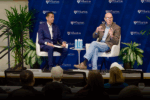
Two people are engaged in a discussion on stage at a Wharton event. They are seated in chairs, with plants and branded banners in the background.

In the second episode of Creative Intelligence, Kartik is joined by New York Times reporter Cade Metz, who wrote the book “Genius Makers: The Mavericks Who Brought AI to Google, Facebook, and the World,” in front of a live audience at Wharton’s San Francisco campus. The pair talk about the titans of modern AI, such as Geoffrey Hinton and Demis Hassabis, the role of AI in art and journalism, and the seemingly contradicting viewpoints of today’s AI leaders.Read More