

When More Data Isn’t Better: Rethinking Granularity in Marketing Analytics

A person speaking into a microphone, with text that reads "AI & Analytics Insights" and "When More Data Isn't Better: Rethinking Granularity in Marketing Analytics" on a blue and purple gradient background.

Choosing the right level of detail when analyzing data—whether by time, geography, or customer segment—is a daily challenge for marketing leaders. New research, by Mingyung Kim (former Wharton PhD student) and her co-dissertation advisors, Eric Bradlow, Wharton Marketing Professor and Vice Dean for AI & Analytics at Wharton, and Raghu Iyengar, Faculty Director, Innovation, Experiential Learning and Research Initiatives, introduces a practical framework for making smarter choices about data aggregation and parameter granularity, with significant implications for forecasting, pricing, and segmentation.Read More

Building Marketing Mix Models with Google Pixel Data Using Meridian

Marketing Mix

University of Pennsylvania students partnered with Google during the Fall 2025 AI & Analytics Accelerator to analyze the impact of the company’s marketing investments. The team explored how different channels contribute to Pixel activations, focusing on uncovering causal relationships rather than relying solely on predictive accuracy.Read More

License‑Level Demand Forecasting for Spencer’s & Spirit Halloween

Spencer's Image

University of Penn students partnered with RxSense for the Spring 2025 AI & Analytics Accelerator. The group worked to to develop a forecasting model to predict drug utilization trends for 2025, enabling RxSense’s clients—pharmacy benefit managers (PBMs) and health plans—to more effectively budget for and manage pharmacy costs. Read More

A Predictive Analytics Collaboration with RxSense

RxSense grqphic

University of Penn students partnered with RxSense for the Spring 2025 AI & Analytics Accelerator. The group worked to to develop a forecasting model to predict drug utilization trends for 2025, enabling RxSense’s clients—pharmacy benefit managers (PBMs) and health plans—to more effectively budget for and manage pharmacy costs. Read More

AI in Our Lives: How Wharton Prepares Students to Lead in the Age of AI

A classroom setting featuring a person giving a presentation to a large group of students. The students are seated with laptops open, engaging with the lecture.

As artificial intelligence continues to shape industries, careers, and daily life, students at the Wharton School have a unique opportunity to explore AI from a behavioral science perspective in the course AI in Our Lives: The Behavioral Science of Autonomous Technology. Taught by Stefano Puntoni, Sebastian S. Kresge Professor of Marketing and Faculty Co-Director of AI at Wharton, this class examines the ways AI impacts individuals, organizations, and society, offering students a chance to critically assess both the benefits and risks of this rapidly evolving technology.Read More

The Future Promise and Risk of Generative AI in Clinical Settings

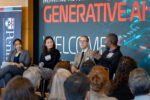
A panel discussion on generative AI, featuring four speakers engaged in conversation. A banner for the Leonard Davis Institute of Health Economics is visible, as well as an audience in the foreground.

Generative AI has the potential to revolutionize healthcare, enhancing diagnostics and enabling more personalized patient care. However, experts at the recent Penn LDI AI in Health Care Conference highlighted significant ethical and practical challenges, including the need for transparency, fairness, and regulation in clinical AI applications. Hamsa Bastani, Faculty Co-Lead of the Wharton Healthcare Analytics Lab, emphasized rigorous testing to reduce bias and ensure AI-driven tools truly improve patient outcomes.Read More