


Reinventing Work in the Age of AI: How Teams, Skills, and Mindsets Must Transform

Two people smiling against a dark blue background, one wearing a black coat and the other in a white shirt.

In Episode 3 of Creative Intelligence, host Kartik Hosanagar is joined by Keith Ferrazzi (author of Never Lead Alone) and Gautam Tambay (CEO of Springboard) to explore what it really means to prepare the workforce for an AI-driven future. Their conversation spans leadership, skill development, team culture, and what’s required to truly redesign work — not just roles.Read More

The People Behind the Machines: What We Learn from the Architects of AI

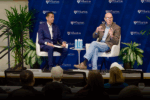
Two people are engaged in a discussion on stage at a Wharton event. They are seated in chairs, with plants and branded banners in the background.

In the second episode of Creative Intelligence, Kartik is joined by New York Times reporter Cade Metz, who wrote the book “Genius Makers: The Mavericks Who Brought AI to Google, Facebook, and the World,” in front of a live audience at Wharton’s San Francisco campus. The pair talk about the titans of modern AI, such as Geoffrey Hinton and Demis Hassabis, the role of AI in art and journalism, and the seemingly contradicting viewpoints of today’s AI leaders.Read More

How AI Can (Actually) Transform Education: Key Takeaways from Sal Khan & Kartik Hosanagar

Two people smiling; one is holding a phone, and the other faces forward, both against a dark blue background.

In the pilot episode of Creative Intelligence – a podcast about the intersection of AI, creativity, and human potential – host Kartik Hosanagar, Faculty Co-Director of Wharton Human-AI Research, speaks with Sal Khan, Founder and CEO of Khan Academy, about the role AI plays in education, Khan Academy’s new AI tool, Khanmigo, challenges with AI use in education, and why, even with all of the concerns around AI, Sal remains an optimist. Here are five key takeaways from their conversation. Read More

Designing an AI-Ready Framework for Chief Data Officers to Maximize AI Value

A robotic hand and a human hand reaching towards each other with their index fingers touching, creating a small light spark at the point of contact, symbolizing human-technology connection.

On June 6th, 2024, AI at Wharton partnered with Informatica to bring dozens of industry leaders and Chief Data Analytics Officers (CDAOs) to Wharton’s campus for a collaborative brainstorming session with many of our leading AI academics. Their goal was to design a framework for companies and their CDOs to reference in order to responsibly and effectively leverage generative AI and increase value for their firms. We are thrilled to now publish the result of their combined efforts through a new white paper: “Designing an AI-Ready Data Framework for CDOs to Maximize AI Value.”Read More

AI Chatbots Seem as Ethical as a New York Times Advice Columnist

Digital Chatbot And Notifications Message Alert Screen Icon And Sent To Recipient On Laptop, Artificial Intelligence, Innovation And Technology.

(Outlet: Scientific American) Large language models lack emotion and self-consciousness, but they appear to generate reasonable answers to moral quandaries. Professor Christian Terwiesch, Co-Director of the Mack Institute of Innovation Management, spoke with Scientific American about his research on AI and its ability to provide input on ethical decision-making.Read More

We’re Focusing on the Wrong Kind of AI Apocalypse

An abstract illustration of a humanoid figure with a digital interface and robotic arms, symbolizing artificial intelligence and automation.

(Outlet: Time) Ethan Mollick, Associate Professor at the Wharton School and Academic Director, Wharton Interactive, challenges the apocalyptic focus on AI risks and emphasizes the immediate threats of misinformation, deep fakes, and AI proliferation. He highlights the need for organizations to make informed decisions about AI’s impact on work and learning, emphasizing it requires thoughtful management and integration to avoid potential negative outcomes.Read More